

Drug use as a global threat. Prevention of drug addiction in the Republic of Belarus
Drug use as a global threat. Prevention of drug addiction in the Republic of Belarus
11 March 2022
The materials were prepared by the Academy of Public Administration under the President of the Republic of Belarus based on information from the Investigative Committee of the Republic of Belarus, the Ministry of Internal Affairs of the Republic of Belarus, the Prosecutor General's Office of the Republic of Belarus, the Ministry of Education of the Republic of Belarus, the Ministry of Information of the Republic of Belarus, the Ministry of Health of the Republic of Belarus, the Commissioner for Religious and National Affairs, and the RPO "Belaya Rus"
Drug addiction is one of the major problems facing the entire global community. According to the World Drug Report 2021, published by the United Nations Office on Drugs and Crime, about 275 million people worldwide used drugs in the past year, and more than 36 million people suffered from drug use disorders.
The number of people using drugs has increased by 22% compared to 2010. A forecast based on demographic changes suggests that by 2030 the number of people using drugs worldwide will increase by another 11% (according to experts, each patient with drug addiction involves 5 to 17 people in drug use during their lifetime).
Thus, drug use is a major problem that requires close and unflagging attention from both the state and each of us. As a reminder of its importance, events are held around the world every year on March 1 as part of the International Day against Drug Abuse and Illicit Drug Trafficking.
General situation with drug addiction in the Republic of Belarus: figures and facts
Attention speakers: from here on it is advisable to provide relevant information and examples applicable to a specific region, territory, or locality.
According to the Ministry of Internal Affairs of the Republic of Belarus, in 2021 there was an increase in the number of patients suffering from drug addiction and under the supervision of a psychiatrist-narcologist of the narcological service of the republic (2021 - 12,833 people, 2020 - 12,346, 2019 - 12,664).
Of these, 7,321 people were under dispensary observation in connection with the syndrome of dependence on narcotic drugs and psychotropic substances, and 5,512 were under preventive observation.
According to the Ministry of Health of Belarus, among patients under dispensary observation with drug dependence syndrome, the most frequently used drugs and psychoactive substances (hereinafter referred to as PAS) are opium, psychostimulants and cannabis (marijuana). At the same time, many patients used two or more drugs at the same time or alternated them.
Drug addiction is predominantly a male disease. Among those registered with drug addiction treatment, women constitute a minority – 15.25% (1,454 people).
Drug addiction is a “young” disease. Most often, drugs are used by people aged 21–40 (79.2%), 41–50 (11.87%).
Drug addiction is an "urban" disease. Drug use is more common among city dwellers (93.4%) than rural residents (6.6%).
Drug addiction is a disease of less educated people. The largest number of drug addicts have secondary specialized education - 43.9%, secondary general - 38.8%, vocational - 9.3%, incomplete secondary - 4.8%, higher - 3.2%.
Drug addiction is a disease of people without a life partner. The marital status of drug users under medical supervision: single (not married) - 51.8%, married (married) - 29.2%, divorced (divorced) - 16.7%, widower (widow) - 2.3%.
Drug addiction is a disease of working people. Depending on social status, working people predominate among drug addicts – 49.0%. Almost a third (30.2%) are non-working (over 20 years old), 9.2% are neither students nor working (under 20 years old).
Of particular concern is the situation with the spread of drugs among young people, which is becoming one of the most acute social problems of all modern states.
It should be noted that in Belarus in 2021, 8 minors were registered under dispensary observation with drug dependence syndrome (in 2019 and 2020, they were not registered). Compared to 2020, the number of minors under preventive observation increased by 2.6 times (in 2021, there were 64 minors, in 2020 - 24, in 2019 - 39).
There are no legal drugs in the Republic of Belarus. All drugs are prohibited and controlled. Any actions with them are illegal and persons involved in drug trafficking are subject to prosecution in accordance with the Criminal Code of the Republic of Belarus (hereinafter referred to as the CC) or the Code of the Republic of Belarus on Administrative Offenses (hereinafter referred to as the Administrative Offenses Code).
According to the Ministry of Internal Affairs of the Republic of Belarus, in 2021 there was a significant increase in the number of crimes related to illegal drug trafficking. Thus, law enforcement agencies identified 4,643 drug crimes (2020 - 3,541, 2019 - 4,276), of which 2,545 were related to drug trafficking (2020 - 1,780, 2019 - 2,184).
As a negative trend, it should be noted the increase in the proportion of minors who were charged under Article 328 of the Criminal Code of the Republic of Belarus "Illegal trafficking in narcotic drugs, psychotropic substances, their precursors and analogues" from 2% in 2020 to 4.3% in 2021, as well as persons charged with committing illegal drug trafficking as part of organized groups (from 2.6% to 10.5%).
In 2021, 111 persons under the age of 18 were brought to criminal responsibility for illegal drug trafficking. Most of them have a particularly serious offense, which carries a prison sentence of 6 to 15 years (Part 3 of Article 328 of the Criminal Code).
Negative impact of drugs on human health. Social consequences of drug use
Some may consider the above figures to be insignificant for a country with a population of over 9 million people, but this is a misconception.
Firstly, these are not just numbers, each of them represents a person's fate. In fact, every drug addict has relatives - mother, father, sister, brother, grandmother, grandfather, husband, wife, children, etc. As a result, one person's problem turns into a real disaster for a dozen people around him.
Secondly, it should be remembered that drug addiction is a serious, virtually incurable disease caused by dependence on a narcotic or psychotropic substance, which destroys the brain, mental and physical health, and ends in premature death. This disease is characterized by a person’s severe dependence, his physical and mental state, on the drug.
All narcotic substances of natural or synthetic origin are poisons that intoxicate the human body. Every organ system of the human body (respiratory system, heart, gastrointestinal tract, nervous system, etc.) is susceptible to the influence of drugs.
Drugs have no less destructive effects (compared to the human body) on the psycho-emotional sphere. At the same time, personality changes manifest themselves quite quickly and clearly. The most noticeable personality changes include:
- deformation of priorities - the drug addict ceases to be interested in anything other than the opportunity to get another dose;
- difficulties with self-analysis – the patient cannot justify some of his actions, sees the problem not in himself, but in those around him who refuse to understand and accept him;
- a decrease in the level of social responsibility – drug addicts are often caught committing crimes and other acts that they would never have committed before;
- lack of motivation – lack of interest in work, acquiring new skills, self-development.
People suffering from drug addiction are unable to fulfill their social obligations. A person does not notice how drugs become a vital necessity, displacing family values, friends, work, sports, etc. Personality degradation occurs.
For reference
The overall degradation of personality as a result of drug use occurs 10-15 times faster than from alcohol.
Drug users are characterized by high mortality rates in the working age group. Every death from drugs is not only a tragedy for the family, but also an economic loss for the state.
In addition to fatalities and accidents in acute psychotic states, suicides as a result of depression and dysphoria (a form of morbidly low mood characterized by gloomy irritability and a feeling of hostility towards others) should be mentioned here. Some researchers assess drug addiction as a "prolonged" suicide.
For reference
The risk of suicide increases by 200 times with alcoholism, by 350 times with drug addiction. The overall mortality rate increases by 2-10 times with alcoholism, by 30 times with drug addiction. Alcohol abuse shortens life by 15-20 years; the malignancy of drugs exceeds the harm of alcoholic beverages so much that drug abuse is not a reduction in life, but its duration. The life expectancy of In 2021, 651 citizens were admitted to healthcare facilities with a diagnosis of "psychosomatic substance poisoning" (2020 - 446, 2019 - 381), of which 19 were minors (2020 - 2, 2019 - 4).
In 2021, 651 citizens were admitted to healthcare facilities with a diagnosis of "psychosomatic substance poisoning" (2020 - 446, 2019 - 381), of which 19 were minors (2020 - 2, 2019 - 4). In 2021, there were no fatal poisonings among minors, but in the country as a whole, 140 people died from drug overdoses (2020 - 89, 2019 - 49).
For reference
A terrible story happened in July of this year in Minsk. Three tenth-graders, wanting to get a thrill, bought methadone. Fortunately, one of them had common sense and refused to "taste". The other two could not resist and inhaled the powder. A couple of minutes later, they could no longer stand on their feet. A sober friend took one of them home and put him to bed, and sat the other on a bench near the entrance to his house.
The parents of the first one raised the alarm only in the morning, when they could not wake up their son, they called an ambulance. The news of the hospitalization quickly reached the friend who took him home, and he began to inquire about the fate of the second friend. As shocking as it was, he found him lying near the same bench. Neither passers-by nor the parents cared about the young guy all this time.
Both young men spent a long time in intensive care. Unfortunately, despite all the doctors' efforts, one of the boys could not be saved.
The system of providing drug addiction treatment in the Republic of Belarus
The prolonged effect of drugs on the addict leads to the complete destruction of the entire organism as a whole. A person is not able to refuse to take these drugs on his own, he needs urgent help.
In the Republic of Belarus, state policy in the field of providing drug addiction treatment is aimed at creating conditions for maintaining, strengthening and restoring the health of citizens, improving the moral and psychological situation of people suffering from addiction to psychoactive substances in the family, team, and society.
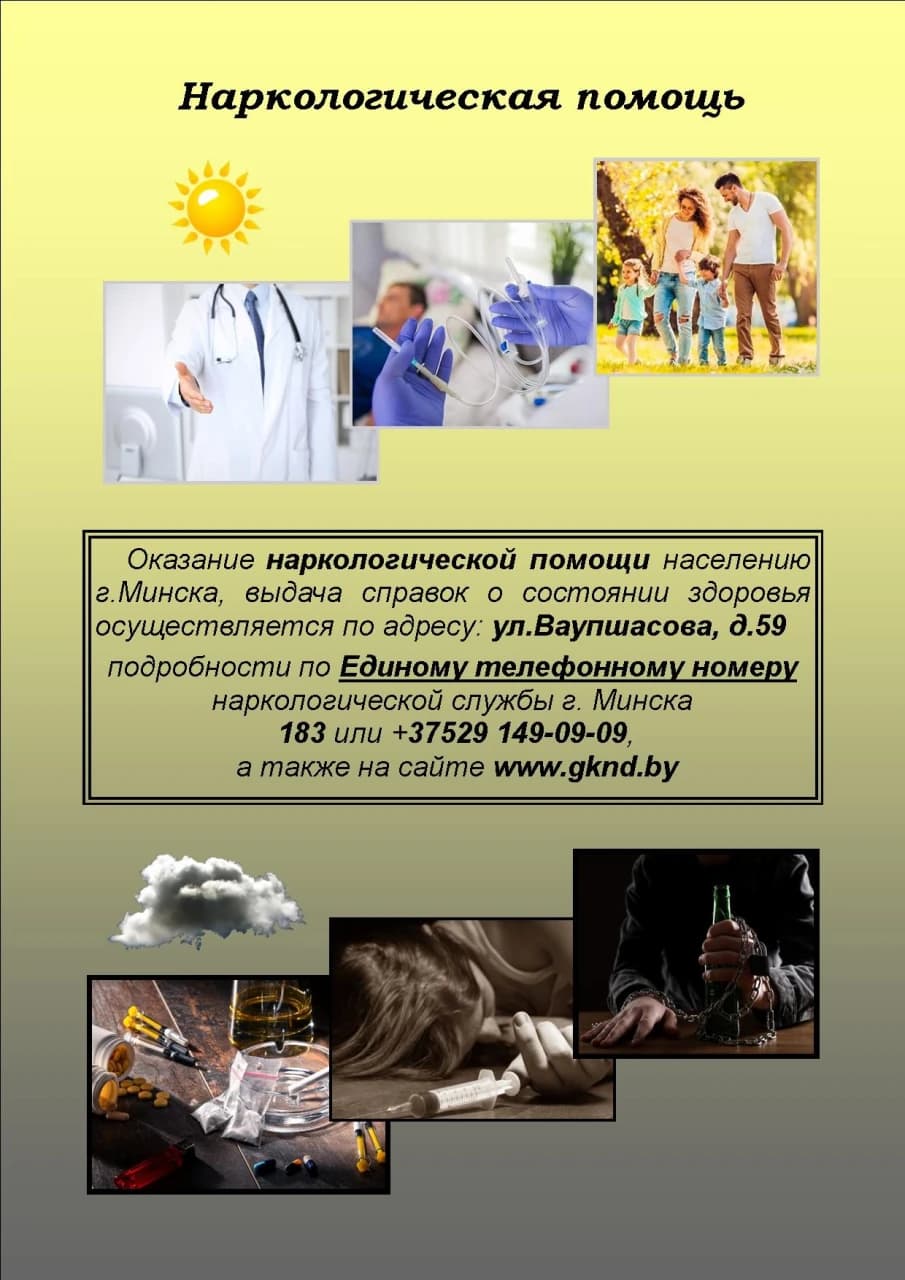
Based on state social standards, drug addiction treatment is free. This treatment can be provided in healthcare organizations both in outpatient and inpatient settings, in day care departments, and outside healthcare organizations (for persons serving sentences in the penitentiary system). For persons who have applied to a healthcare organization voluntarily (on a paid basis), anonymous treatment is provided without being registered with a drug addiction service.
In all regions of the republic, rehabilitation departments (centers) for patients with drug addiction are functioning. Rehabilitation is carried out by multidisciplinary teams of specialists (psychiatrist-narcologist, psychotherapist, psychologist, social worker).
The Ministry of Health of the Republic of Belarus pays special attention to the development of hospital-substituting technologies, as well as to increasing the effectiveness of drug treatment through active interaction with public organizations and religious denominations (ROO "Mothers against Drugs", BPO "Positive Movement", NGO "Anonymous Narcotics" and others), which contributes to increasing the duration of remission of people dependent on psychoactive substances.
Harm reduction programs are available for injecting drug users. Methadone substitution therapy (prescribing methadone to replace injectable opioids, supported by WHO and the UN, hereinafter referred to as MST) has been implemented in all regions of Belarus for over 10 years. As of January 1, 2022, 707 patients with opioid dependence syndrome were taking MST in Belarus.
Social support is provided for patients of the MMT program; all of them are provided with psychological assistance, as well as assistance from a social worker in finding work, restoring documents, and obtaining the necessary medical care.
Narcological care in the ZTM offices is integrated into the provision of care to HIV-infected patients. Close interaction between a psychiatrist-narcologist and an infectious disease specialist allows for simultaneous substitution therapy and antiretroviral therapy.
Counteracting the spread of drugs in the Republic of Belarus: state and public initiatives. Work on the prevention of drug addiction among young people
The basis of activities to prevent and combat the spread of drug addiction is the active interaction of government agencies and public organizations.
In Belarus, special attention is paid to work on drug prevention among young people. For these purposes, educational institutions closely cooperate with such constructive public associations as the Belarusian Republican Youth Union (BRSM), the Belarusian Republican Pioneer Organization (BRPO), the Belarusian Committee of Youth Organizations (BCYO), the Association of UNESCO Clubs, and the Belarusian Red Cross Society. A Cooperation Program is being implemented between the Ministry of Education and the Belarusian Orthodox Church.
Work with young students is carried out within the framework of academic subjects and disciplines, through elective and optional courses, as well as outside of school hours through social, leisure, sports, and work activities.
For reference
For many years, large-scale preventive projects have been implemented aimed at developing the value of health and health-preserving behavior in minors:
- «My lifestyle today is my health and success tomorrow!»,
- «My choice is to live with positivity»,
- «In defense of life»,
- «Healthy behavior is my choice»,
- «Healthy childhood is a happy future».
In general secondary education institutions, the interdepartmental information project “School – Territory of Health”, events of the sixth school day, competitions of the Republican Spartakiad of schoolchildren, held taking into account the interests and age characteristics of students, are being implemented.
The emphasis in the activities of educational institutions to combat the spread of drugs is placed on information and educational work.
For reference
Videos and social advertising prepared by the Ministry of Internal Affairs and the Television News Agency are being actively distributed.
An interactive banner with an active link to the banner “Youth against drugs” (posted on the information site “Youth of Belarus”) has been placed on the official websites of educational institutions, information and preventive videos have been distributed in parent chats on social networks and messengers.
At the initiative of the ROO "Belaya Rus", the campaign "Belaya Rus - against drugs" is held annually, within the framework of which preventive measures are organized with all categories of citizens.
For reference
Particular attention is paid to discussing issues of drug addiction prevention and developing healthy lifestyle skills among students: dialogue platforms “Drug Addiction. Point of No Return”, “Building the Future Together”, “The Health of the Nation in the Hands of the Young People”, round tables “Youth Against Drugs”, etc.
In work collectives, primary organizations of the ROO "Belaya Rus" organize information corners "Talking to your child about HIV" and "Be an example to your child", family bike rides "For safety together", thematic information meetings are held, etc.
Religious organizations of various faiths take an active part in events to prevent and combat drug addiction.
The Coordination Center of the Belarusian Orthodox Church (hereinafter referred to as the BOC) for combating drug addiction and alcoholism in honor of the holy martyr Boniface, which has been operating since 2011 and works in the following areas:
- primary prevention of addictions (aimed at preventing the use of psychoactive substances) – work with young people and teenagers;
- secondary prevention of addictions (includes work with people at social risk, i.e. those who already have experience using psychoactive substances and their relatives);
- tertiary prevention of addictions (rehabilitation and social adaptation of alcohol and drug addicts).
For reference
Tertiary prevention of addictions is carried out by the following specially created structures: the rehabilitation center of the Belarusian Exarchate "Anastasis", the center for spiritual rehabilitation of alcohol and drug addicts (village Lysaya Gora, Minsk region), the religious community "Parish of the Church of the Icon of the Mother of God "Inexhaustible Chalice" in Minsk, the center for the protection of motherhood "Matulya", etc.
Religious organizations of the Roman Catholic Church in the Republic of Belarus (hereinafter referred to as the RCC) are also actively working to combat drug addiction. Thus, spiritual and educational work is carried out among “difficult” teenagers by the youth mission “Pure Heart” at the Minsk-Mogilev Archdiocese of the RCC (jointly with the Main Directorate of Internal Affairs of the Minsk City Executive Committee); regular meetings of Alcoholics Anonymous and their families are held at churches in Minsk; preventive measures are carried out for teenagers to prevent drug addiction and other addictions in the parishes of the Grodno Diocese of the RCC.
The United Church of Christians of the Evangelical Faith, the organizations of Evangelical Christians Baptists, the religious association of churches of Christians of the Full Gospel, the republican religious association "Conference of Churches of Seventh-day Adventist Christians in the Republic of Belarus" also contribute to the prevention and combating of drug addiction. In Jewish and Muslim religious communities, the emphasis is on promoting a healthy lifestyle among believers.
Anti-drug propaganda in the Republic of Belarus
In Belarus, work is constantly being carried out on issues of informational counteraction to the illegal distribution of drugs and the prevention of drug addiction.
All state-owned print and broadcast media inform the public about the problem of drug addiction, the progress of the fight against illegal trafficking of narcotic drugs, psychotropic substances, their analogues, judicial practice and the results of the consideration of cases of this category, measures taken in the area of drug addiction prevention, and the conduct of joint actions with government agencies.
For reference
In 2021, more than 8.5 thousand materials on this topic were published in state media and on their Internet resources, as well as on social media pages, Telegram channels, and messengers.
Media editors closely cooperate with law enforcement agencies in all areas of their activities and coverage, including in terms of obtaining operational information about high-profile events.
Round tables are held, interviews are held with medical workers and representatives of the Ministry of Internal Affairs, information about hotlines and other information provided by the relevant interested bodies is posted.
Thus, the Investigative Committee regularly informs the public about its interaction in the field of combating illegal drug trafficking with other government agencies and foreign colleagues.
Currently, the Investigative Committee has launched an interactive flash mob #talkwithateenager, aimed at attracting the attention of parents, guardians, legal representatives and the public to the problem of the distribution and consumption of drugs, their impact on the body of a teenager, as well as the criminalization of actions in the sphere of illegal drug trafficking.
For reference
The department's employees conducted 967 lectures, discussions and meetings with young people and work collectives on issues of drug addiction prevention.
The media has stepped up its work to discuss and post anti-drug materials on the forums of the most popular Internet resources, in social networks and blogs. Much attention is paid to healthy lifestyles, the inadmissibility of drug use and distribution, and the inevitability of punishment.
The Ministry of Information of the Republic of Belarus restricts access to Internet resources and online publications in the event of dissemination of information promoting the use of narcotic drugs and other intoxicating substances, as well as information about the methods and techniques of production, use and places of purchase of narcotic drugs.
For reference
In total, as of January 1, 2022, decisions were made to restrict access to 1,519 information resources and components of resources that contained information on the sale of narcotic drugs.
In order to reduce the level of distribution and consumption of narcotic drugs, the Ministry of Information of the Republic of Belarus, together with the Ministry of Internal Affairs of the Republic of Belarus and other interested parties, has prepared an Information Strategy for the Prevention of Drug Use and Combating Illegal Drug Trafficking in the Republic of Belarus for 2020–2025. Also, the Ministry of Information, together with government agencies, organizations, and the media, has developed a Plan for the implementation of the Information Strategy for the Prevention of Drug Use and Combating Illegal Drug Trafficking in the Republic of Belarus.
For reference
The goal of the Strategy is to develop by 2025 an information field in the country that will effectively influence the reduction of the level of distribution and consumption of narcotic drugs, psychotropic substances and their analogues.
The main objectives include promoting public understanding of all aspects of the phenomenon of drug addiction, as well as combating the spread of drugs; forming a persistent negative attitude in society towards the illegal drug trade and consumption; creating a positive image of the state in matters of combating the illegal drug trade, preventing drug use, and social rehabilitation of drug addicts; forming in society an awareness of the inevitability of punishment for the illegal production and distribution of drugs; involving the public, including children and young people, in activities to combat the illegal drug trade and prevent drug use, etc.
Responsibility provided in the Republic of Belarus for the use and illegal trafficking of narcotic drugs
Criminal liability in the area of illegal drug trafficking is prescribed in Articles 327–332 of the Criminal Code. For illegal drug distribution, as provided for in Article 328 of the Criminal Code, liability begins at the age of 14 and allows for punishment in the form of imprisonment from 3 to 25 years.
For reference
In accordance with current legislation, illegal sale of drugs means both their paid and gratuitous transfer to other persons, which can be carried out through sale, donation, exchange, payment of a debt, lending, or other means.
Criminal liability for illegal trafficking of narcotic drugs, psychotropic substances, their precursors and analogues, as well as their consumption in a public place or appearing in a public place or being at work in a state caused by the consumption of narcotic drugs, psychotropic substances, their analogues, toxic or other intoxicating substances, is provided for in Articles 328 and 328² of the Criminal Code.
Illegal manufacture, processing, acquisition, storage, transportation or shipment of narcotic drugs, psychotropic substances or their precursors or analogues without the purpose of sale shall entail punishment in the form of restriction of liberty for a term of up to 5 years or imprisonment for a term of 2 to 5 years (Part 1 of Article 328 of the Criminal Code), with the purpose of sale – imprisonment for a term of 3 to 20 years with or without a fine (Parts 2–4 of Article 328 of the Criminal Code).
In the case of the sale of narcotic drugs, which, through negligence, resulted in the death of a person as a result of their consumption, the punishment provided is imprisonment for a term of 12 to 25 years with or without a fine (Part 5 of Article 328 of the Criminal Code).
The legislation of the Republic of Belarus also provides for administrative liability for a number of offenses in the specified area, such as the consumption of drugs in a public place without a prescription from a specialist doctor, as well as refusal to undergo a check (examination) in the established manner to determine the condition caused by their consumption, appearing in a public place in a condition caused by the consumption of the said substances, and others (parts 3–5 of Article 19.3 of the Code of the Republic of Belarus on Administrative Offenses).
Unfortunately, despite the broad information campaign being conducted in the country to prevent drug addiction, there are many examples where even young men and women aged 15–17, students of higher and secondary specialized institutions, and even schoolchildren were detained by police officers for illegal drug trafficking.
Today, the main resource for drug distribution has become the Internet, of which each of us is an active user.
Many people have experienced how tempting advertising can be about the possibility of making quick, easy, and most importantly, significant money.
The organizers of online stores and drug sales sites promise huge amounts of money for just a minor service, sometimes hiding the true goals and the object of income.
As a rule, no one ever sees those who are on the other side of a computer, smartphone or other gadget.
The drug business today is faceless, cruel, unprincipled and merciless. The only goal of such employers is to enrich themselves at the expense of the fates, lives and health of young and naive people.
By agreeing, a person becomes a drug distributor, and for the employer - a spending coin. The payment of the reward will be constantly delayed, the next batch of drugs will have to be purchased at their own expense, and so on until the police knock on the "employee's" door. As a rule, this happens within 2 weeks to 1.5 months, and some are delayed at the first attempt to earn easy money. And then, as usual, tears and the realization of what happened, but it's too late.
Many who have embarked on the dangerous path of drug trafficking at some point still realize that they have made the wrong choice and want to get out of this business, but it turns out that desire alone is not enough.
Recruiters, as a rule, when hiring a person, require passport data, which in such cases they use for blackmail and threats, promising to publicize their illegal activities. And the fear of this makes them continue to work for the "master" until the already known end.
In addition, today a new threat requires a response, related to the advertising of online stores that carry out criminal activities in the sphere of illegal turnover of psychoactive substances. As a rule, this is expressed in the application of graffiti or the pasting of stickers in public places with advertising in the form of a link to a specific online store and the indication of the drugs sold by it.
A separate danger comes from the position of adults who are convinced that drugs will affect anyone but their family.
Education and trusting communication should always start with the family. It is the foundation of children's well-being. And the more convincing the parents are, the more useful this communication will be for both parties.
It turns out that many parents still do not know that the Internet and gadgets not only contribute to the development of the child, but also pose a serious threat to safety. Trying not to violate the child's personal space, not paying attention to changes in his behavior, not knowing the circle of communication and not delving into the lifestyle, dads and moms learn about the consequences too late. And the information that the "good" daughter or son has become drug dealers or drug addicts comes as a complete surprise. ***
Drug addiction and illegal drug trafficking are becoming a threat to the social, political, demographic, economic, and internal security of any modern state.
In our country, issues of combating illegal drug trafficking and preventing drug use are given special attention by all interested government agencies and organizations. However, as practice shows, for more effective combating drug addiction and drug trafficking, the participation of the entire society is necessary.
Latest publications